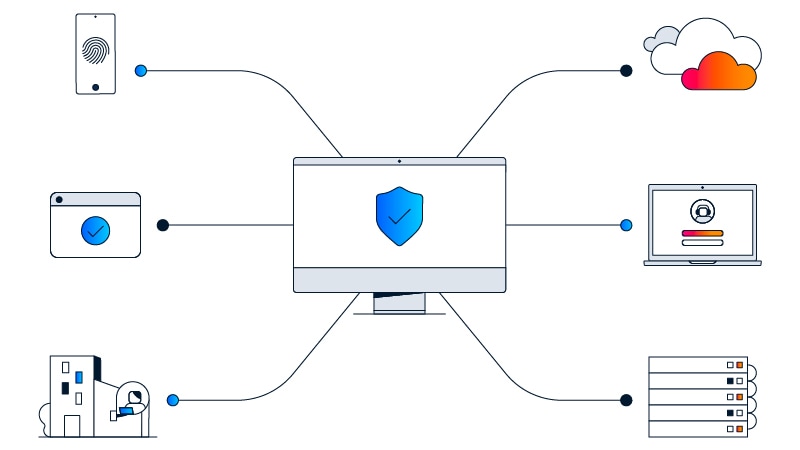
| Form factor | Where it deploys | Primary role |
|---|---|---|
| Hardware firewall | Branch, campus, data center perimeter | Physical enforcement at network boundaries |
| Virtual firewall | Private and public cloud, virtualized data center | Software enforcement for virtualized workloads |
| Cloud-native firewall | Public cloud environments (AWS, Azure, GCP) | Native enforcement integrated with cloud provider infrastructure |
| Firewall-as-a-service (FWaaS) | Delivered from the cloud to remote users and branches | Cloud-delivered enforcement without on-premises hardware |
For a definition of firewalls and how next-generation firewalls evolved, see What is a firewall?
How a hybrid mesh firewall differs from traditional firewall deployment
| Capability | Traditional / NGFW deployment | Hybrid mesh firewall |
|---|---|---|
| Enforcement location | Centralized at network perimeter or zone | Distributed across hardware, virtual, cloud-native, and FWaaS |
| Policy management | Per-device or per-zone, often siloed by environment | Unified policy plane across all enforcement points |
| Threat intelligence | Applied per device or per cluster | Shared consistently across all enforcement points |
| Performance model | Traffic backhauled to inspection points | Inspection applied close to workload, reducing latency |
| Operational model | Multiple consoles, often by vendor or environment | Single management plane, multi-vendor orchestration |
The role of unified management
Unified management is the defining capability of a hybrid mesh firewall. A single management plane allows security teams to define policy once and apply it consistently across hardware, virtual, cloud-native, and FWaaS enforcement points, including those from multiple vendors. This eliminates the configuration drift and policy gaps that occur when different environments are administered through separate consoles.
Where a hybrid mesh firewall fits in a broader security architecture
A hybrid mesh firewall is one component of a broader Zero Trust security strategy. Network segmentation and microsegmentation are key enforcement mechanisms that operate alongside the firewall layer, particularly in data center and cloud environments. For organizations adopting Zero Trust principles, distributed firewall enforcement complements identity-based access controls and continuous verification across users, devices, and workloads.
Firewalling needs to evolve to meet today’s challenges
1990-2007
Stateful Firewall
Drivers
- Growing internet access
- Basic attacks
- Need perimeter control
Needs:
- Tracks connection state
- Filters by IP/port
- Basic traffic control
2008-2024
Next Generation Firewall
Drivers
- Rise of SaaS/cloud apps
- Mobile users
- App layer threats
Needs:
- App and user aware
- Integrated threat prevention
- SSL/TLS decrypt
2025-
Hybrid Mesh Firewall
- Distributed application architectures across multi-cloud and edge
- Operational requirement to manage policy across multiple firewall form factors
- Zero Trust adoption requiring enforcement closer to workloads
Key features of a hybrid mesh firewall solution
Unified management
Centralized interface where security policies are defined and orchestrated across all enforcement points, including third-party firewalls. Built-in AI capabilities enable faster troubleshooting and firewall policy optimization.
End-to-end segmentation
Comprehensive zero-trust framework that includes macro and microsegmentation for data center and ccloud- and identity-based segmentation for campus, branch, and IoT environments. Coarse to fine-grained controls (policies) are applied to zones, application workloads, and processes to prevent unauthorized lateral movement.
Integration with cloud-native infrastructure
Cloud-agnostic visibility and enforcement; uses cloud-native automation and orchestration to automatically deploy, network, scale, and heal firewall enforcement points across multi-cloud environments.
Identity-driven policy
Grant or deny access to resources based on context such as user authentication, role, device, behavior, and location, rather than just network location alone.
Application-vulnerability shielding
Mitigate application vulnerabilities by applying a compensating control; shield applications from new or existing vulnerabilities without requiring immediate patches or downtime.
Encrypted traffic inspection
Inspect traffic at scale to detect hidden threats within TLS/SSL session without decrypting.
AI model protection
Apply specialized guardrails to secure AI models and APIs against exploitation.
Threat detection and response
Integrate existing enforcement points with security information and event management (SIEM) platforms to collect telemetry to detect and remediate threats quickly across environments.
Automated policy lifecycle
Discover, test, and validate a security policy in a live environment without affecting the application prior to enforcement. Analyze policy impact on applications overtime and optimize accordingly.
Simplified licensing
Take advantage of licensing that aligns directly to business outcomes and provides the flexibility to easily access new capabilities and innovations as needs evolve.
Solving customer challenges with a hybrid mesh firewall
Problem: Management complexity creates inconsistent security
Organizations traditionally use different firewalls across network perimeters, clouds, branches, and containers, leading to fragmented visibility and inconsistent policies.
Solution: Unified management
A hybrid mesh firewall provides a single management console and allows administrators to express intent once and have policies consistently and automatically updated everywhere—helping to ensure consistent, scalable protection, reduced operational complexity, and fewer misconfigurations.
Problem: Unauthorized lateral movement goes undetected
Flat internal networks allow attackers who breach one node to move freely.
Solution: Network segmentation
A hybrid mesh firewall solution enables organizations to more effectively align their macro and microsegmentation approaches to prevent unauthorized movement across the network. It limits north-south and east-west traffic and embeds zero-trust policies on workloads to protect critical applications and contain breaches. This directly combats ransomware and advanced persistent threat (APT) tactics that depend on lateral movement of attacks.
Problem: New threat vectors introduced by AI
The development and deployment of AI models and apps introduce new avenues for cyberattacks and data privacy violations for organizations. These attacks include prompt injections, AI model poisoning, and data leakage.
Solution: AI application protection
A hybrid mesh firewall solution continuously validates AI models and apps to detect vulnerabilities and mitigate risks while also enforcing native guardrails directly on its enforcement points to protect AI models and apps from threats.
Problem: Keeping up with growing vulnerability landscape
Continuously growing list of critical vulnerabilities and exposures (CVEs) make it hard to prioritize CVEs and limit exploitation during patch development.
Solution: Exploit protection
A hybrid mesh firewall solution helps organizations prioritize CVEs and shield vulnerabilities from exploits to buy time for patch development.
Problem: Performance bottlenecks and latency
Central firewall chokepoints can't keep pace with today's traffic volumes, especially for AI/ML or IoT data.
Solution: Distributed security enforcement
Distributed enforcement means security is applied locally, at line rate, avoiding backhaul latency and separate from network packet processing. This is crucial for edge computing and real-time apps where cloud roundtrips are too slow.
Problem: Blind spots due to lack of security telemetry
Capturing and centralizing all logs in a SIEM for high-fidelity alerts and threat hunting is inefficient and costly.
Solution: Distributed, federated architecture
A hybrid mesh firewall leverages distributed intelligence for security monitoring, meaning each enforcement point can preprocess data, forwarding only pertinent alerts—yielding faster threat detection at a lower cost on central SIEM ingestion.
Benefits of a hybrid mesh firewall solution
Improved performance
Distributed security placed as close to the application as possible simplifies network design, removes performance bottlenecks, latency, and reduces cost.
Reduced risk
AI-powered threat intelligence combined with comprehensive security stops advanced threats, prevents unauthorized lateral movement, safeguards vulnerabilities from exploits, and protects the development and deployment of AI, thereby reducing the attack surface from current and emerging threats.
Simplified operations
Centrally managed enforcement points enable you to write a policy once and enforce it across environments. This reduces manual labor and overhead associated with administering policies across disparate tools and environments, resulting in increased efficacy and faster time to value.
Lower total cost of ownership
Simple licensing, unified management of enforcement points, AI-driven automation, and orchestration means faster time to value and reduced overhead.
Future-proofed for AI adoption
Add security as your business needs evolve without rip and replacement; defend against novel threats targeting AI models and applications.
Hybrid mesh firewall FAQ

What is a firewall?
A firewall decides whether to allow or block specific traffic based on security rules.
What is network segmentation?
Network segmentation improves security and performance by dividing a network into smaller parts.
What is an exploit?
An exploit is a program built to take advantage of system vulnerabilities.
What is microsegmentation?
Microsegmentation isolates application workloads to deliver consistent security policies.
What is ZTNA?
Zero-trust network access (ZTNA) is a strategy to verify users' access.
What is an AI data center?
AI data centers are specialized facilities with vast computational power to handle complex workloads.