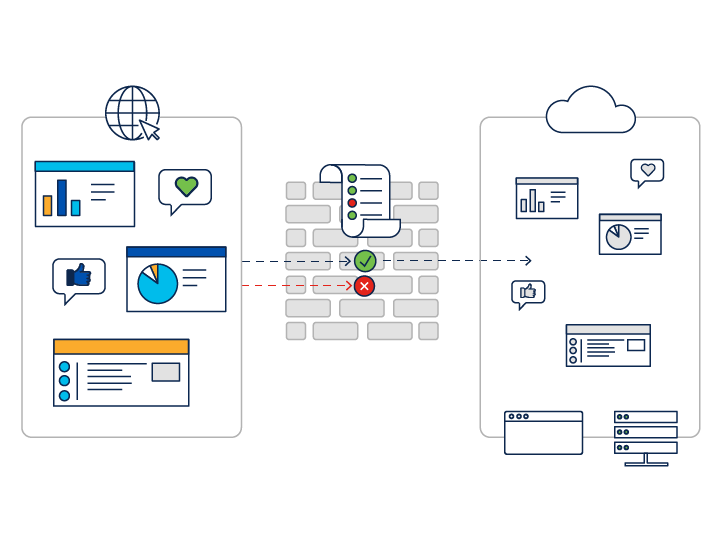
What is a WAF?
Web application firewalls (WAFs) are a critical security defense for websites, mobile applications, and APIs. They monitor, filter, and block data packets to and from web applications, protecting them from threats. WAFs are designed (trained) to detect and protect against dangerous security flaws that are most common within web traffic. This makes them essential for online businesses like retailers, banks, healthcare, and social media, which need to protect sensitive data from unauthorized access. WAFs can be deployed as network-based, host-based, or cloud-based solutions, providing visibility into application data at the HTTP application layer.
Since web and mobile applications and APIs are prone to security risks that can disrupt operations or exhaust resources, web application firewalls are designed to counter common web exploits like malicious bots. WAFs safeguard against threats that compromise availability, security, or resources including zero-day exploits, bots, and malware.
How does a WAF work?
A WAF works by inspecting HTTP requests and applying predefined rules to identify malicious traffic. It can be software, an appliance, or a service. The WAF analyzes the following key parts of HTTP conversations:
- GET requests: These requests retrieve data from the server.
- POST requests: These requests send data to the server to change its state.
- PUT requests: These requests send data to the server to update or create.
- DELETE requests: These are requests to delete data.
The WAF also analyzes the headers, query strings, and body of HTTP requests for malicious patterns. If the WAF finds a match, it will block the request and send an alert to the security team.
Why is WAF security important?
WAFs are crucial for the security of online businesses. They protect sensitive data, prevent leaks, prevent malicious code from being injected into the server, and meet compliance requirements like Payment Card Industry Data Security Standard (PCI DSS). As organizations increasingly use more web apps and IoT devices, attackers try to target their vulnerabilities. Integrating a WAF with other security tools, such as endpoint protection and identity security, creates a layered defense strategy.
How does WAF contribute to web app security?
Many applications today are created using a combination of home-grown, third-party, and open-source code. WAFs add an extra layer of security to inadequately built or legacy applications and help to enhance secure design practices by blocking common attack vectors and preventing malicious traffic from reaching the application. Below is a list of significant advantages specific to WAFs.
- WAFs can block malicious traffic before it reaches a web application, preventing data breaches and other attacks.
- WAFs can help to protect sensitive data, such as credit card numbers and customer Personally Identifiable Information (PII), from unauthorized access.
- WAFs can help to meet compliance requirements, such as PCI DSS, by blocking traffic that violates those requirements.
- WAFs can work in conjunction with other security tools, such as an intrusion detection system (IDS), intrusion prevention system (IPS), and firewalls, to create a layered defense that is more effective at preventing attacks.
What is the difference between WAF and other tools?
What is the difference between WAF and a network firewall?
A next-generation firewall (NGFW) protects a broad range of network traffic, filtering by IP, port, and protocol and adding application awareness, intrusion prevention, and threat intelligence. A web application firewall is more specialized: it protects web and application servers from common web application attacks, such as SQL injection and cross-site scripting.
The key difference is how a WAF sees traffic. A WAF is typically deployed as a reverse proxy, which lets it fully inspect each web request — whether sent over HTTP or HTTPS — before passing it to the end server. This makes a WAF function like a more limited, specialized firewall focused specifically on web application traffic. Most organizations use both: an NGFW to secure network traffic broadly, and a WAF to protect the web applications and servers behind it.
For the general firewall definition, see What is a firewall?
Do web applications need a firewall?
By positioning WAF in front of web apps, it safeguards them collectively. Its effectiveness against attacks such as cross-site scripting and injection attacks is a significant feature.
How does the HTTP protocol relate to WAF?
WAF intervenes to scrutinize legitimate requests, thwarting attacks like injection, cross-site scripting, HTTP Flood, and Slowloris, ensuring safer web interactions.
What are the differences between WAF, IPS, and NGFW?
Here are the basic differences between a WAF, an IPS, and a next-generation firewall (NGFW). While an IPS is signature-based and broad in focus, operating at Layers 3 and 4, a WAF operates at the application layer (Layer 7). A WAF protects web applications by analyzing each HTTP request, and traditional WAFs ensure allowed actions based on security policies. NGFWs are advanced firewalls with integrated IPS and application-layer capabilities.